Crypto Dice Odds vs. Traditional Dice

Crypto Dice Odds vs. Traditional Dice
Crypto dice games and physical dice games differ in how they handle randomness, player control, and payout structures. Crypto dice platforms use blockchain-based random number generators and provably fair systems, allowing players to verify each roll's fairness. In contrast, physical dice rely on trust in manufacturing standards and casino oversight, with no way to verify individual outcomes post-roll.
Key differences include:
- Crypto Dice: Adjustable odds, customizable win probabilities, low house edge (around 1%), and instant payouts. Players can verify results using cryptographic hashes, ensuring transparency.
- Physical Dice: Fixed probabilities based on physics, higher house edge (2%-10%), and no post-roll verification. Outcomes depend on dice quality and casino regulations.
Quick Comparison
| Feature | Crypto Dice | Physical Dice |
|---|---|---|
| Outcome Range | 0.00–99.99 | Fixed (e.g., 1–6 per die) |
| Win Probability | Adjustable (e.g., 1%-98%) | Fixed by physics (e.g., 16.67%) |
| Verification | Cryptographic, provably fair | None, trust-based |
| House Edge | ~1% | 2%-10% |
| Payout Speed | Instant | 1-5 business days |
| Customization | Full control over risk/reward | None |
Crypto dice games offer more control, transparency, and efficiency, making them appealing for players seeking fairness and flexibility. Physical dice games, while simpler, rely heavily on trust and have fewer options for player input.
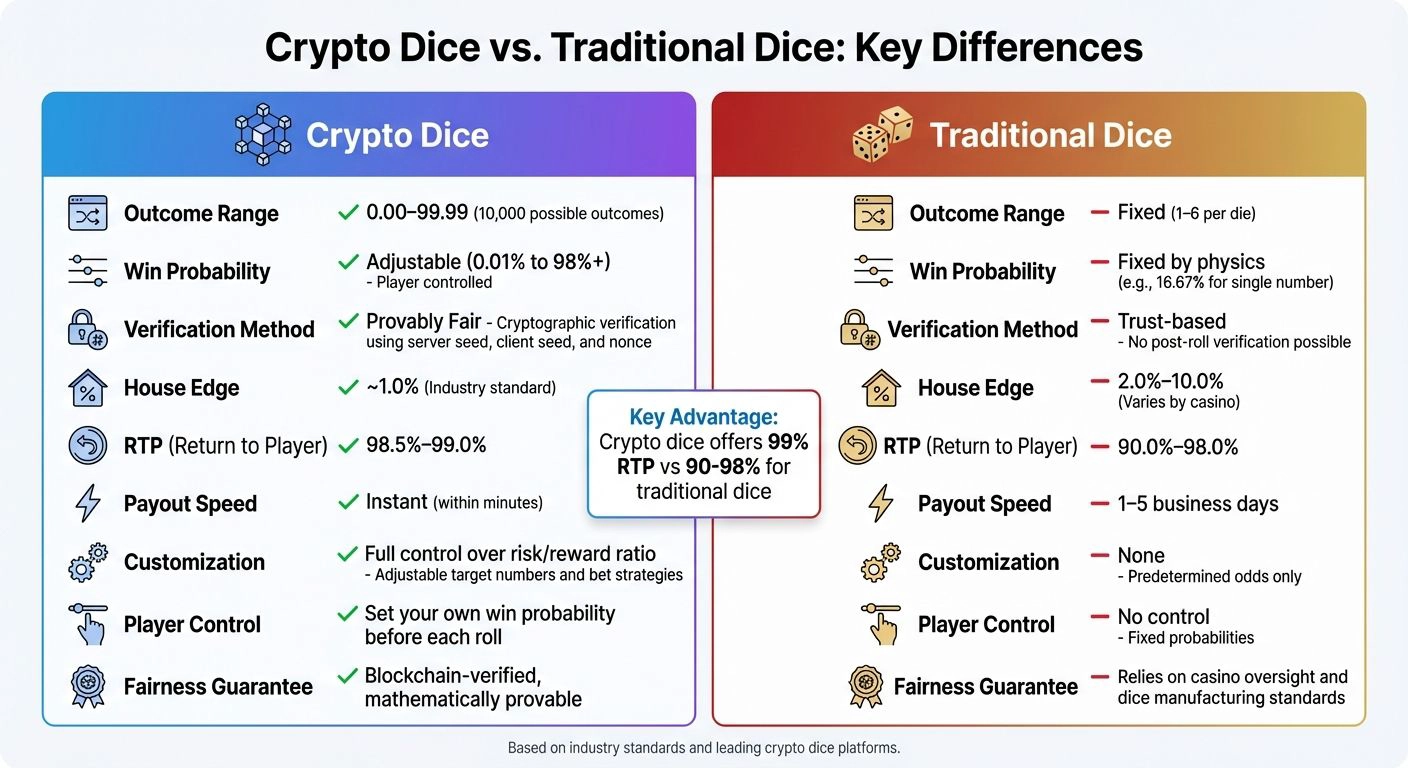
Crypto Dice vs Traditional Dice: Complete Comparison Chart
The Mathematics of the Casino | What people get wrong about gambling
How Traditional Dice Games Work
Physical dice have been around for thousands of years, with some of the oldest examples discovered in Iran's "Burnt City", dating back to 2800–2500 BCE. These early dice evolved from fortune-telling practices involving animal knucklebones, and for much of history, people believed that supernatural forces determined the outcomes. It wasn’t until the last 500 years that the concept of mathematical probability started replacing mystical beliefs about dice rolls. This shift not only changed how people viewed dice but also laid the foundation for understanding the math behind each roll.
"Before [the last 500 years], people really did think that supernatural or unseen forces were the ones guiding the dice!" – Crypto.Games
The appeal of traditional dice games lies in their simplicity: you predict an outcome, roll the dice, and compare the result. This straightforward mechanic has allowed dice games to endure across generations and cultures.
Calculating Probability with Physical Dice
A standard six-sided die has an equal chance of landing on any face, meaning the probability of rolling a specific number is 1/6, or about 16.67%. This is calculated by dividing one favorable outcome by the total number of possibilities.
When rolling two six-sided dice, the math gets a little more interesting. There are 36 possible outcomes (6 × 6), and the probability of rolling a specific sum depends on how many combinations produce that result. For example, rolling a 7 is the most likely outcome because it can occur in six different ways: (1,6), (2,5), (3,4), (4,3), (5,2), and (6,1). This gives it a probability of 6/36, or 16.67%. On the other hand, rolling a 2 or 12 is much less likely, as each can only happen one way (1,1 or 6,6), resulting in a 1/36 (2.78%) chance.
| Sum | Combinations | Probability |
|---|---|---|
| 2 or 12 | 1 | 2.78% |
| 3 or 11 | 2 | 5.56% |
| 4 or 10 | 3 | 8.33% |
| 5 or 9 | 4 | 11.11% |
| 6 or 8 | 5 | 13.89% |
| 7 | 6 | 16.67% |
As you add more dice, the calculations become more complex. For example, with three six-sided dice, the most common sums are 10 and 11, each with a 12.5% chance. The distribution of outcomes begins to form a bell curve, where middle numbers are more likely than extremes.
Verifying Fairness in Physical Dice
Fairness in dice games depends heavily on the quality of the dice themselves. Casinos use precision dice that are manufactured to exacting standards. These dice typically measure about 3/4 inch (19.05 mm) on each side and are made from translucent cellulose acetate, which makes it easier to detect internal tampering or weights.
To prevent cheating, casino dice include unique serial numbers and logos, which help identify and prevent the use of altered or "loaded" dice. Additionally, regulations, such as those in New Jersey, specify that standard casino dice cannot exceed 0.775 inches (19.7 mm). Players can also inspect dice for transparency and ensure that opposite faces add up to seven (1-6, 2-5, 3-4), which is the standard layout.
However, physical dice ultimately rely on trust. While inspections can reveal obvious tampering, there’s no way to verify the fairness of each individual roll after it happens. The outcomes are determined by physical dynamics, leaving no room for post-roll validation. This contrasts with digital dice systems, which can use cryptographic methods to prove fairness. Despite these limitations, traditional dice games continue to thrive, blending precise engineering with the timeless excitement of chance.
How Crypto Dice Games Work
Crypto dice games take the traditional idea of dice rolling and bring it into the digital age. Instead of tossing physical dice, these games rely on blockchain-based random number generators to produce outcomes, usually on a scale from 0.00 to 99.99. Everything happens online, with results displayed instantly and payouts processed within minutes.
What sets crypto dice apart is the ability to adjust the odds dynamically, adding a layer of strategy. Players can tweak their win probabilities using sliders or input fields. For example, you might go for a safer bet with a 90% chance of winning, which offers a smaller payout, or take a bigger risk with a 10% chance of winning for a much higher multiplier. This flexibility turns a game of fixed odds into one where you control the balance between risk and reward.
Another appealing feature is the speed and automation of these platforms. Many sites offer an "autobet" function that can handle hundreds of rolls per minute, making it ideal for players experimenting with high-frequency strategies. The low minimum bets also make the game accessible to everyone, from casual users to seasoned gamblers. Winnings are credited instantly, so you can withdraw or reinvest right away.
Game Mechanics and Betting Options
At its core, the gameplay is simple: you pick a target number and bet whether the roll will land "over" or "under" that threshold. Players wager cryptocurrencies like Bitcoin, Ethereum, or Tether, and their payouts depend on the difficulty of their prediction. For instance, if you set your target at 50.00 and bet "over", any roll between 50.01 and 99.99 results in a win. The harder the prediction - like rolling over a high number such as 98.00 - the higher the payout multiplier.
Most platforms operate with a 1% house edge, offering a 99% return-to-player (RTP) rate. The payout multiplier is calculated using this formula: (100 ÷ Win Probability) × (100 - House Edge) ÷ 100. For example, if you choose a 49% win chance on a platform with a 1% house edge, your multiplier would be around 1.98x. This level of transparency allows players to understand their potential returns before placing a bet.
Platforms like Windice also support fractional betting with very low minimums, making it easier to test strategies that involve a high volume of small-stakes bets. Since bets are settled instantly, there’s no downtime - you can review your results and jump into the next round without delay. These mechanics are backed by a provably fair system, ensuring every roll is trustworthy.
Provably Fair Systems Explained
One of the standout features of crypto dice games is the use of provably fair technology, which lets players verify that every roll is random and tamper-free. This system relies on three cryptographic elements: a server seed (generated by the casino), a client seed (customizable by the player), and a nonce (a counter that increments with each bet).
Here’s how it works: before you place a bet, the casino provides an encrypted hash of the server seed. After the roll, the casino reveals the unhashed server seed. You can then combine this with your client seed and the nonce using a SHA-256 calculator to verify the roll. If the resulting hash matches the pre-roll hash, you know the game was fair.
As Marcus, an expert in casino strategies, explains:
"Provably fair transforms crypto dice from a trust-based system into a verification-based one, where transparency isn't just promised - it's cryptographically guaranteed." – Marcus, Casino Strategies & Tips
This system gives players the power to audit rolls in real time. If any tampering occurs, it can be detected immediately by running the verification process. This shifts the trust model from "just trust the casino" to "verify the math yourself", making crypto dice distinct from both physical dice games and traditional online gambling platforms that use opaque algorithms.
Probability Mechanics: Crypto vs. Traditional Dice
When comparing physical dice to crypto dice, the key difference lies in how probabilities are handled. Traditional dice stick to fixed odds dictated by physics, while crypto dice introduce adjustable probabilities, letting players control their risk and reward. This fundamental distinction shapes the strategies and mechanics of each type of game.
Fixed Odds in Physical Dice Games
In traditional dice games, probabilities are set in stone. A standard six-sided die has six outcomes, each with a fixed probability of 1/6 (about 16.67%). For example, in games like craps, rolling two dice results in 36 possible combinations. A total of 7, the most common outcome, appears in 6 of those combinations, giving it a fixed probability of 16.67%.
Adjustable Odds in Crypto Dice Games
Crypto dice, on the other hand, operate in a digital environment where probabilities are not fixed but customizable. These games use a random number generator (RNG) to produce results between 0.00 and 99.99, creating 10,000 possible outcomes. Instead of betting on a specific number, players choose a target and wager on whether the roll will land "over" or "under" that threshold.
For example:
- A target of 10.00 gives a 90% win chance with a 1.1× payout.
- A target of 90.00 gives a 10% win chance with a payout of roughly 9.9×.
Payouts are calculated using the formula:
(100 ÷ win probability) × 0.99.
| Feature | Traditional Physical Dice | Crypto Dice Games |
|---|---|---|
| Outcome Range | Fixed (1–6 per die) | Adjustable (0.00–99.99) |
| Win Probability | Fixed by physics (e.g., 16.67%) | Fully adjustable (0.01% to 98%+) |
| Player Control | None - odds are predetermined | Full control - set your own risk/reward |
| Payout Structure | Fixed by house rules | Dynamic - scales with chosen win chance |
| House Edge | Typically 2.0% to 5.0% | Typically 1.0% |
This flexibility allows players to tailor their approach. Conservative bets with 80–90% win chances offer steady, smaller gains, while high-risk bets with win chances under 1% can yield multipliers up to 99×. Platforms like Windice make this even easier with user-friendly interfaces and quick bet settlements, letting players seamlessly adjust their strategies.
House Edge and RTP Comparison
House edge and RTP are crucial for understanding how much of your wager is likely to return over time. These metrics highlight a key difference between traditional and crypto dice games.
How House Edge Works in Both Formats
The house edge reflects the casino's built-in advantage over players. In traditional casino dice games, this edge typically falls between 2% and 10%. For every $100 wagered, the casino keeps $2–$10, depending on the game.
Crypto dice games, however, operate with much leaner margins. Most reputable platforms offer a house edge of around 1%, meaning players get back approximately $99 for every $100 wagered. While this difference may seem minor at first glance, it can significantly impact your bankroll over time, as higher house edges drain funds faster.
Platforms like Windice leverage blockchain technology to reduce fees and streamline operations. This allows them to offer competitive house edges, instant payouts, and provably fair systems. Many crypto dice platforms also enhance player value with rakeback programs, returning a portion of the edge to players on every bet.
RTP Percentages and Examples
RTP (Return to Player) is calculated as 100% minus the house edge. For instance, a 1% house edge results in a 99% RTP, while a 5% edge translates to a 95% RTP. Leading crypto dice games often feature RTPs of 99%, far exceeding the 90% to 95% range commonly found in traditional casinos, whether physical or fiat-based.
| Feature | Crypto Dice | Traditional/Fiat Dice |
|---|---|---|
| Typical House Edge | 1.0% – 1.5% | 2.0% – 10.0% |
| Typical RTP | 98.5% – 99.0% | 90.0% – 98.0% |
| Fairness Verification | Provably Fair (Blockchain verified) | Third-party RNG audits only |
| Payout Speed | Instant (minutes) | 1–5 Business Days |
To calculate a game's house edge, subtract its RTP from 100. You can also verify the fairness of a platform's multipliers using this formula: (100 - House Edge) ÷ Win Chance. For example, with a 50% win chance and a 1% house edge, the multiplier should be about 1.98×.
This breakdown of house edge and RTP lays the groundwork for understanding how to develop strategies tailored to each dice format.
Player Strategies for Each Format
Traditional and crypto dice games require different approaches due to variations in odds, house edge, and how outcomes are verified. By understanding these differences, you can tailor your strategy to suit each format.
Let’s break down the tactics that work best for each type of game.
Strategies for Physical Dice Games
In traditional dice games, your strategic options are fairly limited because the odds are fixed. The focus often shifts to staking systems like Martingale (doubling your bet after a loss) or D'Alembert (increasing bets incrementally after losses) to manage bankroll swings. However, these systems can't overcome the house edge, which typically ranges between 2% and 5% in most casino dice games.
Ultimately, the only real choices you have are how much to bet and when to walk away. While these games are entertaining, the house edge ensures that long-term profitability is unlikely.
Strategies for Crypto Dice Games
Crypto dice, on the other hand, offer far more flexibility. Players can set their win probabilities before each roll. Most platforms let you pick a target number (usually between 0.00 and 99.99) and bet whether the roll will be "over" or "under" that number. This creates what’s called a Risk-Reward Spectrum, where you can choose between frequent, low-risk bets or rare, high-reward bets.
For example:
- Betting "Roll Under 90" gives you an 89% chance to win with a payout of about 1.11×.
- Betting "Roll Under 5" offers only a 5% chance to win but a much higher payout of approximately 19.6×.
Platforms like Windice provide this level of customization while maintaining a low house edge of just 1%.
"The real edge in crypto Dice isn't just in the numbers - it's in how you play them." - Bitrollers
Advanced players often use tools like Autobet to automate their bets. This allows them to adjust bet sizes, set profit goals, or alternate between risk levels without constant manual input. Since crypto dice results are provably fair, you can verify every roll using cryptographic seeds, eliminating the need to trust the platform blindly.
A common strategy among experienced players involves combining high-probability bets (80–90% win chances) to steadily grow their bankroll, with occasional high-reward bets to aim for bigger payouts. This balance of risk and reward, paired with verifiable fairness and a lower house edge, opens up opportunities unavailable in traditional dice games.
As cryptocurrency writer Vlad Hategan puts it:
"The perfect dice player is a disciplined strategist who treats the game as a math problem rather than a gamble." - Vlad Hategan, Expert Cryptocurrency Writer, Bitedge
These strategies highlight how crypto dice games offer a more dynamic and customizable experience compared to their physical counterparts. This sets the stage for diving deeper into how these formats perform overall in the next section.
Conclusion
Crypto dice operates on mathematical verification, setting it apart from traditional dice games that rely on trust. In conventional setups, players must rely on the casino's Random Number Generator and third-party audits. Crypto dice eliminates this reliance by using provably fair systems, ensuring transparency through cryptographic methods.
Another advantage of crypto dice is its adjustable odds. Unlike traditional dice games with fixed probabilities, players can modify their win chances between 0.00 and 99.99. This customization directly impacts the payout multiplier, allowing players to tailor the risk and reward to their preferences. Combined with a standard 1% house edge (equating to a 99% RTP), this flexibility offers a level of control and fairness not found in physical dice games.
"Provably fair transforms crypto dice from a trust-based system into a verification-based one, where transparency isn't just promised - it's guaranteed by cryptography." - Marcus, Casino Strategy Expert at Wolfbet
This shift does more than ensure fairness; it enhances the overall player experience. Platforms like Windice highlight these benefits by allowing players to verify every roll through its Fair Game section. Windice supports six major cryptocurrencies, maintains the industry-standard 1% house edge, and fosters a vibrant community with features like a $3,000 weekly Dice Wagering Contest and an interactive chat system where players exchange strategies and verify outcomes together.
FAQs
How can I verify that a crypto dice roll is fair?
You can check the fairness of a crypto dice roll using provably fair technology, a system designed to guarantee transparency in outcomes. The process involves verifying the hashed server seed given before the roll, comparing it to the revealed server seed afterward, and factoring in the client seed and nonce. Many platforms provide tools that let you validate these values, ensuring the roll was random and free from manipulation.
Do adjustable odds change my long-term expected return?
Adjustable odds in crypto dice games play a significant role in shaping your long-term expected return. By tweaking your betting parameters - like target numbers or strategies - you directly influence the probability of winning each roll, which in turn affects your expected value.
If you lean toward low-risk bets, you'll enjoy more consistent outcomes but with smaller returns. On the other hand, high-risk bets come with the allure of bigger payouts, though they bring greater volatility and a reduced long-term expected value. The choice ultimately depends on your risk tolerance and goals.
Why is the house edge lower in crypto dice?
Crypto dice games stand out because they often feature a much lower house edge compared to traditional casino games. This is thanks to the use of cryptographic algorithms and provably fair systems, which ensure both transparency and fairness. Unlike conventional games, where fixed odds heavily favor the house, crypto dice rely on blockchain-based randomness and verifiable outcomes. This approach builds trust and reduces the chances of unfair practices. Some platforms even offer house edges as low as 1%, which is far below the standard rates in traditional casinos, making these games particularly attractive to players.