How Hash Seeds Work in Crypto Casinos
How Hash Seeds Work in Crypto Casinos
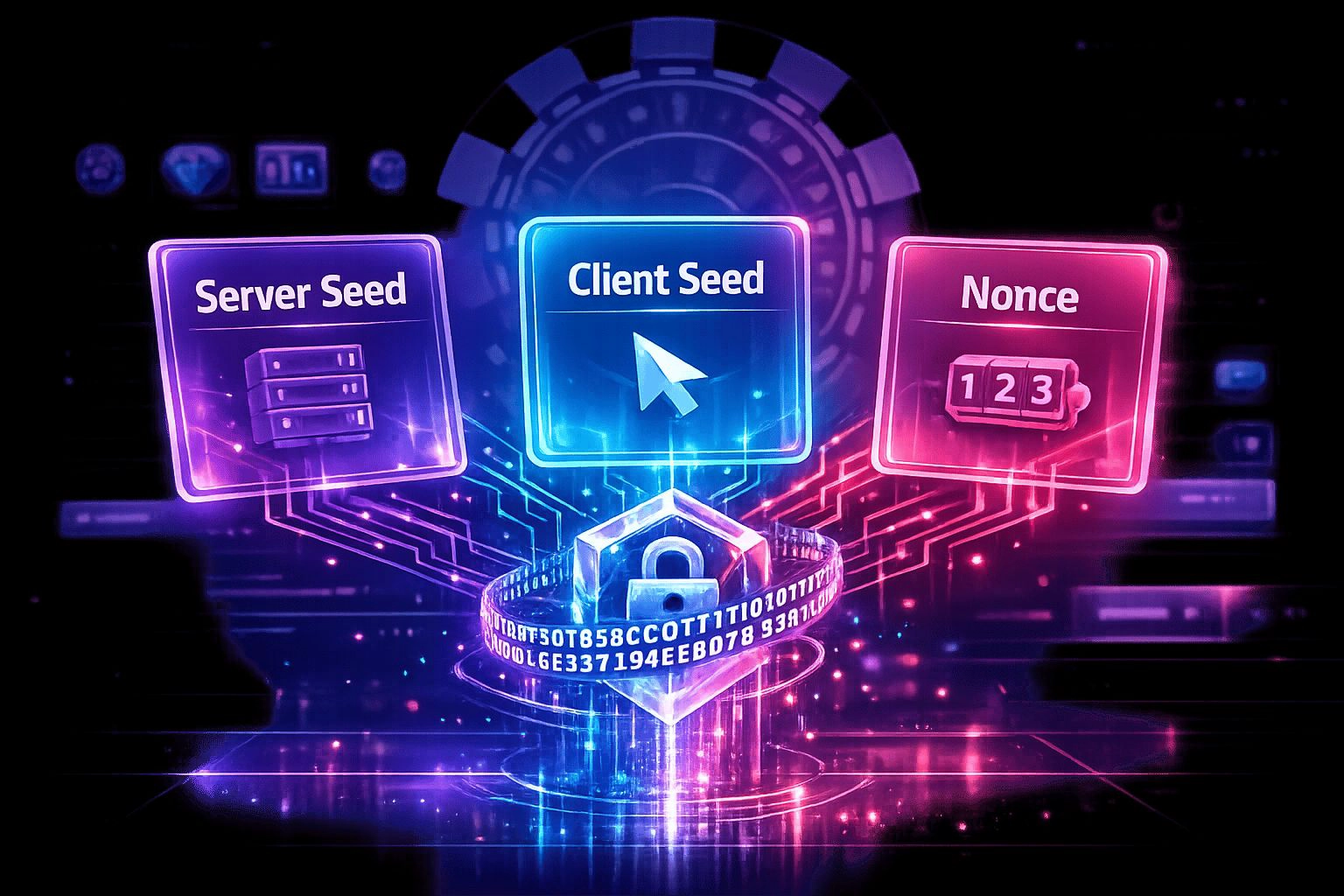
When you play at a crypto casino, how can you be sure the games are fair? The answer lies in hash seeds, a cryptographic system that ensures game outcomes can't be tampered with. Here's the process in simple terms:
- Server Seed: The casino generates a secret string and shares its hashed version with you before you bet. This prevents any changes later.
- Client Seed: You can customize a string that combines with the server seed, giving you control over part of the outcome.
- Nonce: A counter that ensures every bet produces a unique result, even if the seeds stay the same.
These elements work together using algorithms like SHA-256 to generate and verify game results. Post-game, you can check the revealed server seed against its hash to confirm no manipulation occurred. This system eliminates the need to rely on trust, letting you verify every outcome yourself.
Minesweeper Provably Fair
Key Components of Hash Seeds
Hash seeds rely on three crucial elements - server seed, client seed, and nonce - to ensure fairness in games. Together, these components create a system that is both tamper-proof and verifiable.
Server Seed
The server seed is a random string generated by the casino. It’s hashed using the SHA-256 algorithm, producing a 64-character string that locks in the game’s outcome. For example, in July 2024, Gamingtec's GT Studios used this system for their crash games ROCKIT! and BOOM!. The server seed was generated, hashed, and displayed before bets were placed, locking in the crash point multiplier.
"Provably Fair is a cryptographic protocol used in crypto casinos to ensure game outcomes are random and tamper-proof. It combines server seeds, client seeds, and nonces, hashed via algorithms like SHA-256."
Client Seed
The client seed, provided by the player, adds another layer of randomness. Many platforms allow players to customize this string, ensuring the casino cannot pre-calculate outcomes. For instance, BGaming's Provably Fair Roulette uses a system where both the casino’s secret and the player’s input are hashed together to determine results. Before each spin, the system generates and hashes a result and secret, which are shown to the player. After entering their client seed, the final outcome is calculated by combining the player’s input with the pre-generated data.
This process ensures that each player has control over a component of the outcome, making it verifiable and transparent.
Nonce
The nonce is a counter that starts at 0 or 1 and increments with every bet placed. Even if the server and client seeds remain the same, the nonce ensures that each bet produces a unique result.
| Component | Controlled By | Primary Function | Visibility |
|---|---|---|---|
| Server Seed | Casino | Locks in the outcome to prevent manipulation | Hashed before play; revealed after |
| Client Seed | Player | Adds randomness controlled by the player | Fully visible and customizable |
| Nonce | System | Guarantees unique outcomes for each bet | Visible in bet history/fairness tab |
How Hash Seeds Generate Game Outcomes
How Hash Seeds Generate Verifiable Game Outcomes in Crypto Casinos
Once the server seed, client seed, and nonce are set, they come together through cryptographic algorithms to determine game results. This process ensures consistent outcomes and allows for post-game verification, making it a cornerstone of fairness in gaming.
Algorithms Used in Game Outcome Generation
The process relies on HMAC methods, where the server seed acts as the key and the client seed combined with the nonce serves as the message. This setup ensures that neither the player nor the casino can tamper with the results.
"The beauty of this approach lies in its mathematical foundation. Each game result can be independently verified using publicly available information, creating an auditable trail that proves fairness beyond doubt."
- TouMaili, Web Cryptography Specialist
The algorithm generates a 256-bit (64-character) hexadecimal string. For example, in dice games, the first 52 bits (roughly 13 hex characters) of this hash are converted into a decimal number, which is then mapped to a range like 0–99.99.
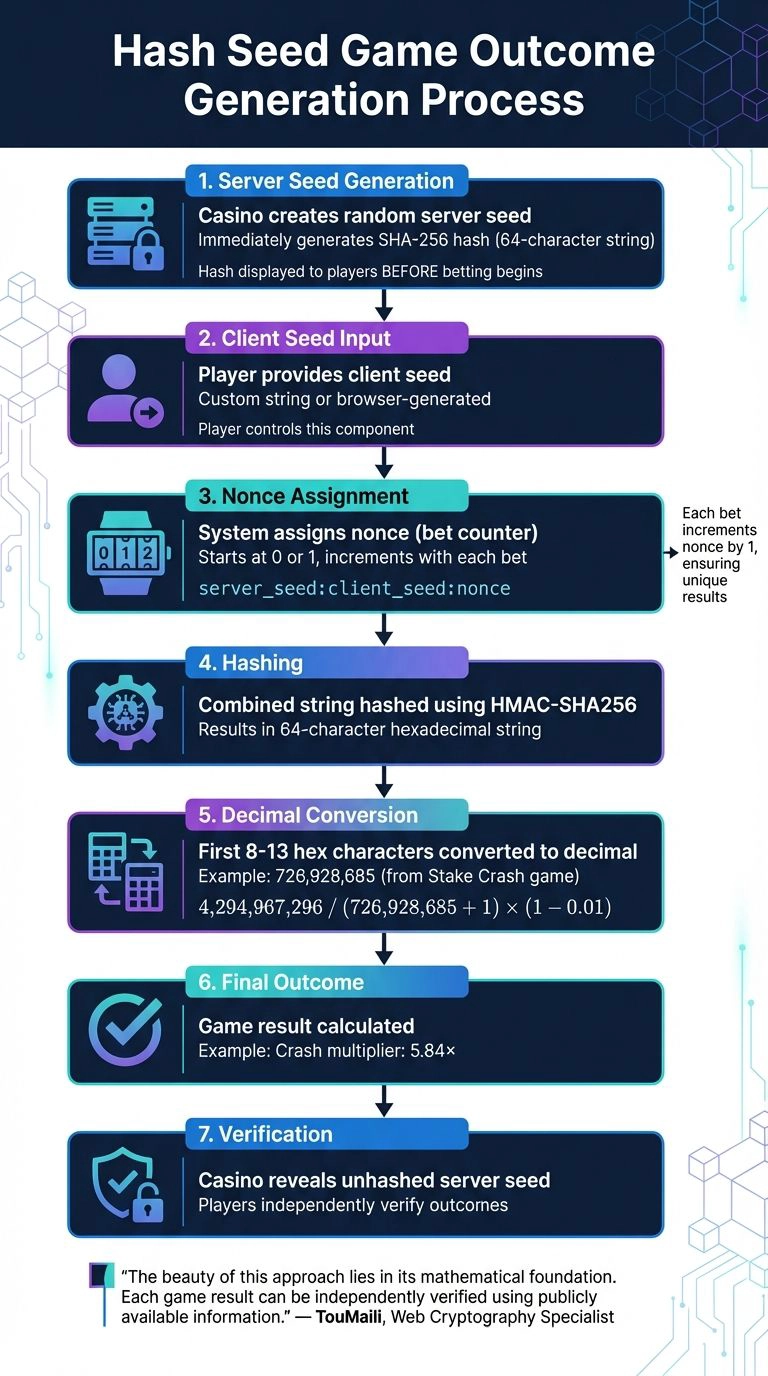
Take Stake's Crash game as an example from October 2025: the first 8 characters of the hash were converted into the decimal value 726,928,685. This number was then processed using the formula:
4,294,967,296 / (726,928,685 + 1) × (1 – 0.01)
The result? A final multiplier of 5.84×. Other games use different methods. For instance, Aviator by Spribe merges three client seeds with a single server seed to produce a SHA-512 hash, while in Blackjack, the hash serves as the basis for a Fisher-Yates shuffle to determine the deck order.
Step-by-Step Process Breakdown
Here’s a closer look at how the seeds and nonce work together to generate a verifiable game outcome:
- Server Seed Generation: The casino creates a random server seed and immediately generates its SHA-256 hash. This hash is displayed to players before betting begins, locking in the seed without revealing it.
- Client Seed Input: You provide a client seed, either by entering a custom string or using one generated by your browser.
-
Nonce Assignment: When you place a bet, the system assigns a nonce, starting at 0 or 1 for the first bet. The server seed, client seed, and nonce are then combined into a single string, formatted like this:
server_seed:client_seed:nonce - Hashing: This combined string is hashed using HMAC-SHA256, resulting in a 64-character hexadecimal string.
- Decimal Conversion: The initial section of the hex string is converted into a decimal number. For example, this might be used to calculate a dice roll value through modulus and division, producing an outcome like 93.8.
- Verification: After the game round ends, the casino reveals the unhashed server seed. This allows players to independently verify the outcomes.
Each time you place a bet, the nonce increments by 1. This ensures that even if the same client seed is reused, every round produces a distinct result. This process guarantees that even the slightest change in input leads to a completely different output. It’s a transparent system that reinforces trust, as players can verify every outcome for themselves.
How to Verify Game Results Using Hash Seeds
Cryptography makes it possible to verify game results without needing to trust the casino blindly. The process involves three key steps: checking the hash before playing, validating the server seed after the game, and independently reproducing the outcome to ensure everything checks out.
Pre-Game Hash Verification
Before you place your first bet, the casino provides a hashed version of the server seed. This is a 64-character hexadecimal string created using SHA-256. Think of it as a digital lock: it commits the casino to a specific server seed while keeping the actual seed hidden. If the casino tries to tamper with the seed later, the hash won’t match, exposing any foul play.
"Hashing is like putting the data inside a locked transparent box. You can see the box is there, but you can't see the numbers inside." - Sophie Langford, Lead Payments & Usability Auditor, Gambling Bitcoin
Make sure to record this hash securely. To avoid predictable outcomes, use a unique client seed - a random string of 10–32 characters - rather than relying on default values.
Once you’ve noted the hash, you’re ready to proceed to the post-game validation step.
Post-Game Seed Disclosure and Validation
After playing, the casino discloses the unhashed server seed. This is where you confirm that the seed matches the hash provided before the game. On platforms like Windice, you can find this option under the FAIR section in your profile menu or at the bottom of the page. Clicking GENERATE NEW reveals the previous server seed while creating a new one for future bets.
To verify, use an independent SHA-256 calculator, such as KeyCDN or Xorbin. Enter the revealed server seed into the tool and check if its hash matches the pre-game commitment. If the two align, it confirms the casino didn’t alter the server seed during your session.
"The hash proves the server seed existed before the bet, but it doesn't reveal what the seed actually is." - Mmazganov, Security Researcher
Reproducing Outcomes for Verification
The final step is to recreate the game results yourself. To do this, you’ll need the unhashed server seed, your client seed, and the nonce (a counter that tracks the bet number). On Windice, you can find these details by clicking SHOW VERIFICATION INFO at the bottom of any bet page.
Combine the values in the format ServerSeed:ClientSeed:Nonce, and run them through an HMAC-SHA256 calculator. The resulting hash will match the one the casino used to determine the outcome. For dice games, take the first eight characters of the hash, convert them from hexadecimal to decimal, and apply the game’s formula to calculate the roll result.
Although Windice provides a built-in VERIFICATION tab for this process, you can double-check using external tools like DevGlan or FreeFormatter for added assurance. While it may feel tedious to verify every bet, it’s worth checking high-stakes rounds or any results that seem unusual.
Benefits of Hash Seeds for Players and Casinos
Hash seeds bring a modern twist to gaming, ensuring fairness while offering real advantages for both players and casinos.
Player Confidence Through Transparency
With hash seeds, the traditional trust model gets a major upgrade. Instead of relying on third-party auditors or taking the casino's word for it, you get a cryptographic "receipt" for every game outcome. The server seed hash, shared before you place your bet, acts as proof that the game is fair. Since your client seed combines with the server seed to determine the result, you actively participate in the randomness, making the process less dependent on the casino's integrity.
Better Security and Tamper Prevention
The pre-commitment system ensures that every game outcome is locked in and can't be altered. By publishing the hashed server seed upfront, casinos prevent any post-bet changes or replay attacks.
This system also protects against internal tampering. Any attempt to deviate from the cryptographic process would be instantly noticeable.
How Windice Implements Provably Fair Gaming

Windice stands out by embracing a fully transparent, player-centric system. It uses a three-part setup: a server seed, a customizable client seed (up to 64 alphanumeric characters), and a nonce. You have the option to manually set or randomize your client seed, ensuring that the casino cannot predict your choice. Windice also provides a dedicated FAIR tab in your profile and at the bottom of the page, giving you direct access to verification tools. Throughout gameplay, the server seed remains hidden and is only revealed when you generate a new one, allowing you to audit past bets.
"In Windice we can manually input our desired Client Seed. We can input a max of 64 numbers or letters long or a combination of both"
- CharorowtzXD, Windice forum contributor
For optimal randomness, it’s recommended to rotate your seeds every 10,000–100,000 bets.
Conclusion
The hash seed system, built on server seeds, client seeds, and nonces, creates a solid foundation of trust in every game. By breaking down the process of generating and verifying hash seeds, crypto casinos offer players mathematical proof of fairness for every bet. Rather than depending on a casino’s reputation or sporadic third-party audits, players can independently confirm that outcomes are fair. The server seed hash locks in the result before the game begins, the client seed lets players influence the randomness, and the nonce ensures each round is distinct.
"Provably fair technology represents a fundamental shift in the relationship between casinos and players. For the first time, the burden of proof lies with the mathematics rather than with trust."
The true power of this technology lies in its ability to eliminate reliance on trust. By using SHA-256, a 256-bit digest protects bets from tampering after the game. Any attempt to alter results after a bet is placed is immediately detectable.
Hash seeds provide players with complete transparency, allowing them to audit every game while enhancing casino credibility and preventing internal manipulation. This system not only aligns with the growing demands of the industry but also builds player confidence. As regulatory entities, such as the Malta Gaming Authority, increasingly prioritize cryptographic transparency for compliance by 2026, hash seeds are quickly becoming a standard practice.
Ultimately, hash seeds revolutionize gambling by making it a process players can verify. When a casino implements provably fair gaming, it sends a clear message: transparency is not just a feature - it’s the cornerstone of online gambling.
FAQs
Can I change my client seed mid-session?
Yes, you can change your client seed during a session. Since the client seed is controlled by the player, you have the option to generate or modify it either before starting or while you’re playing. This helps ensure fairness and keeps the system transparent.
What happens if the server seed hash doesn’t match later?
If the server seed hash doesn’t align later on, it could indicate potential tampering or cheating. This happens because the verification process depends on matching the revealed server seed to confirm the outcome. Any mismatch disrupts this process, casting doubt on the system's integrity. Since the hash plays a key role in maintaining trust and openness in crypto casino games, such inconsistencies can seriously damage confidence in the platform.
Do I need to verify every bet to stay safe?
No, you don’t have to verify every single bet to ensure safety. Provably fair systems take care of that by offering transparency. These systems let you check the results after your bets are placed, so you can trust the process without needing to verify every step in real time. This strikes a balance between convenience and fairness.

'%3e%3cg%20transform='translate(369.602%20987.521)'%3e%3cpath%20d='M856.878,108.886a25.011,25.011,0,1,0,.853,6.48A25.04,25.04,0,0,0,856.878,108.886ZM837.765,138.32a23.507,23.507,0,1,1,17.825-17.508A23.58,23.58,0,0,1,837.765,138.32Z'%20fill='%23c93034'/%3e%3cpath%20d='M813.322,90.966s.236-.5-.3-.336-4.608,1.95-5.179,6.019,2.085,6.76,4.573,6.928,3.867-1.48,3.565-3.4c-.194-1.225-1.984-2.185-2.657-4.2A11.453,11.453,0,0,1,813.322,90.966Z'%20fill='%23bd1e2d'/%3e%3cpath%20d='M812.784,90.832s-5.078,2.555-4.809,7.5c0,0,.437,4.4,4.305,5.044a6.013,6.013,0,0,1-3.464-4.54C808.244,95.4,810.43,92.479,812.784,90.832Z'%20fill='%23ff6b6b'/%3e%3cpath%20d='M812.683,94.195a5.5,5.5,0,0,0,1.447,3.732,6.845,6.845,0,0,1,1.714,2.287,2.418,2.418,0,0,1-.807,2.387s.564-.731-.076-2.21S811.944,96.985,812.683,94.195Z'%20fill='%23940004'/%3e%3cpath%20d='M851.918,90.966s-.235-.5.3-.336,4.607,1.95,5.179,6.019-2.085,6.76-4.574,6.928-3.867-1.48-3.564-3.4c.193-1.225,1.984-2.185,2.656-4.2A11.454,11.454,0,0,0,851.918,90.966Z'%20fill='%23bd1e2d'/%3e%3cpath%20d='M852.457,90.832s5.077,2.555,4.808,7.5c0,0-.437,4.4-4.3,5.044a6.01,6.01,0,0,0,3.463-4.54C857,95.4,854.81,92.479,852.457,90.832Z'%20fill='%23ff6b6b'/%3e%3cpath%20d='M852.557,94.195a5.5,5.5,0,0,1-1.446,3.732,6.844,6.844,0,0,0-1.715,2.287,2.422,2.422,0,0,0,.807,2.387s-.563-.731.076-2.21S853.3,96.985,852.557,94.195Z'%20fill='%23940004'/%3e%3c/g%3e%3c/g%3e%3c/svg%3e)






 232.04