How Blockchain Ensures Fairness in Endorphina Games
How Blockchain Ensures Fairness in Endorphina Games
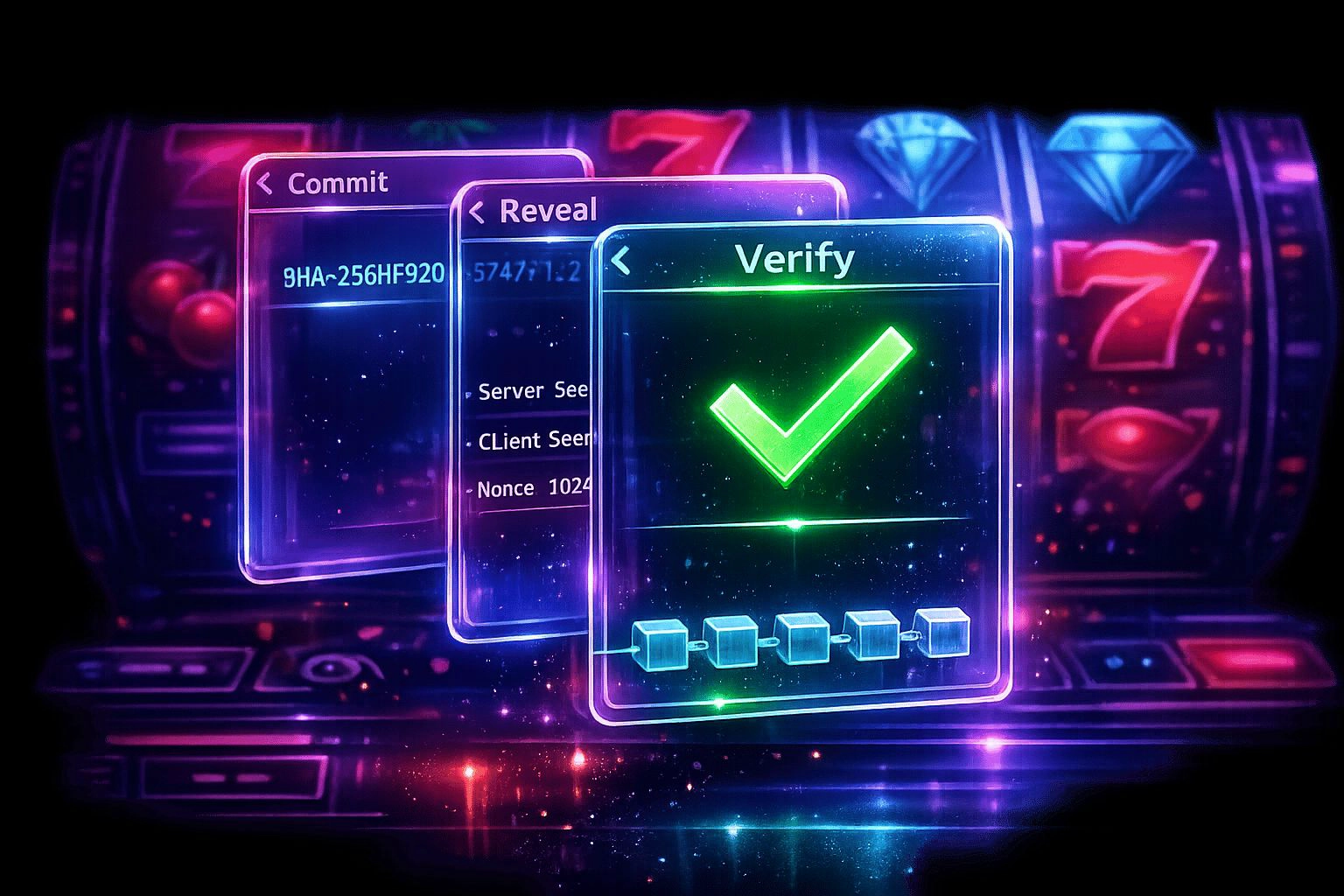
Online gambling has faced trust issues for years, with players questioning the randomness of game outcomes. Blockchain technology changes the game by offering a transparent, tamper-proof system where outcomes can be verified by players themselves.
- Endorphina, a leading gaming company, uses blockchain-based provably fair mechanisms in its slot games.
- The system relies on SHA-256 cryptographic hashes, server and client seeds, and a nonce to ensure game results are locked in and verifiable.
- Players can independently confirm outcomes using tools like HMAC-SHA256 verifiers, eliminating reliance on blind trust.
- Platforms like Windice integrate Endorphina's games, combining blockchain transparency with cryptocurrency payments and community features.
This shift toward blockchain-backed transparency is transforming online casinos, replacing opaque systems with verifiable proof that ensures random, untampered results.
Understanding Provably Fair Gaming And The Transparency Of Blockchain-Based Systems
What Is Blockchain and Provably Fair Gaming?
How Provably Fair Gaming Works: 3-Step Verification Process
Blockchain Basics
At its core, blockchain is a decentralized public ledger that records transactions across a network of computers. This setup ensures data is immutable and transparent, which is a game-changer for online gaming. Why? Because traditional casinos often operate like "black boxes." Once you place a bet, everything happens on private servers, leaving you with no way to verify the results. Blockchain flips this script by making every transaction and game outcome visible on a public ledger.
The technology relies on cryptographic hash functions like SHA-256 to secure data integrity. These one-way digital fingerprints make reverse-engineering impossible and flag any tampering. Even the smallest change in the data creates an entirely different hash, ensuring transparency and reliability. This tamper-proof system is the foundation of provably fair gaming.
How Provably Fair Gaming Works
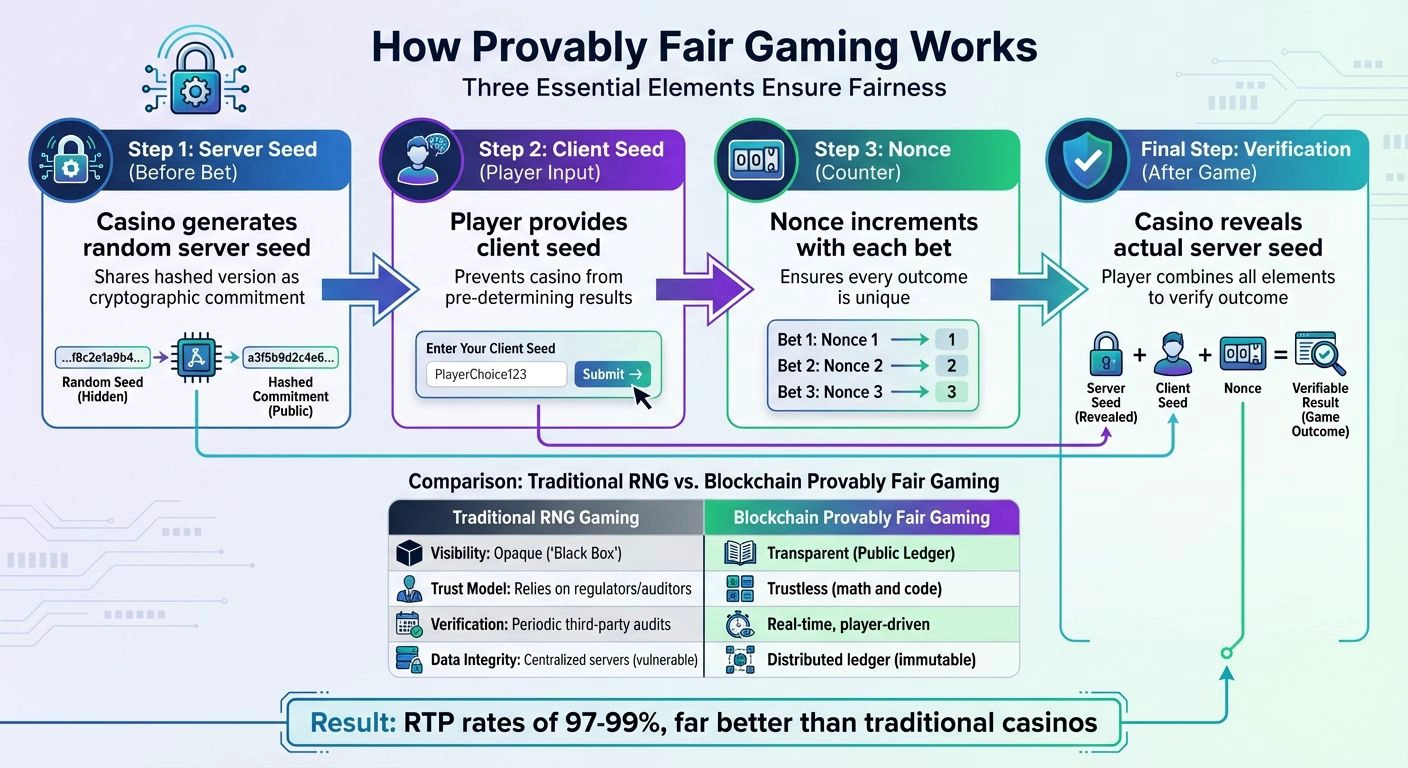
Provably fair gaming uses blockchain's transparency to replace blind trust with mathematical proof. Instead of just trusting that the casino is playing fair, you can verify the results yourself. Here's how it works: three essential elements - server seed, client seed, and nonce - ensure fairness.
- Server Seed: Before you place a bet, the casino generates a random server seed and shares its hashed version. This acts as a cryptographic commitment to a specific outcome.
- Client Seed: You provide a client seed, typically generated by the player. This prevents the casino from pre-determining results.
- Nonce: A counter that increments with each bet, ensuring every outcome is unique, even if the same seeds are reused.
Once the game ends, the casino reveals the actual server seed. You can then combine it with your client seed and the nonce to verify the outcome using a provably fair verification tool. If the math checks out, you know the game was fair.
| Feature | Traditional RNG Gaming | Blockchain Provably Fair Gaming |
|---|---|---|
| Visibility | Opaque ("Black Box") | Transparent (Public Ledger) |
| Trust Model | Relies on regulators or auditors | Trustless, based on math and code |
| Verification | Periodic third-party audits | Real-time, player-driven |
| Data Integrity | Centralized servers (vulnerable to tampering) | Distributed ledger (immutable) |
The result? Games with return-to-player (RTP) rates typically ranging from 97% to 99%, far better than most traditional casino games. This transparency forces operators to focus on fairness instead of hiding behind inflated house edges.
How Endorphina Uses Blockchain for Fair Gaming

Blockchain Implementation in Endorphina Games
Endorphina has embedded fairness directly into its games with the use of provably fair mechanics. This means that every game outcome can be verified through a combination of operator-generated server seeds, player-generated client seeds, and pre-committed cryptographic hashes. Essentially, once you place a wager, the outcome is locked in and cannot be altered.
The company also holds ISO 27001 certification, which underscores its commitment to protecting data integrity. As Džangar Jesenov, Endorphina's Head of Compliance, explains:
"Security has always been a top priority for us - not just for compliance reasons but because we believe in building trust with our partners and players."
Endorphina's security framework is built to operate seamlessly across different jurisdictions, ensuring the integrity of its data worldwide. This approach has already supported the certification of 83 games in Brazil's regulated market. The same secure framework extends to the company's random number generation (RNG) process, ensuring fairness from the ground up.
Random Number Generation and Fairness
Endorphina's RNG system is designed to uphold fairness by leveraging its blockchain integration. It uses a commit-reveal scheme along with SHA-256 cryptographic hashes to make the process tamper-proof. Before each game round begins, the server seed is hashed and pre-committed, locking in the outcome. After the round ends, the actual seed is revealed, allowing players to verify that the result matches the original hash.
To add another layer of security, a nonce - essentially an incremental counter - is used. This ensures that even if the same seeds are reused, each wager produces a completely unique result. Together, these methods make every bet as transparent and fair as blockchain technology allows.
How to Verify Game Fairness in Endorphina Games
Finding Game Seeds and Hashes
To confirm that a game is fair, you need specific data from your session. Start by navigating to the game's History or Settings menu. Look for a Fairness tab, or click on a specific bet ID. From there, copy these four key pieces of information: the Hashed Server Seed (pre-game), the Revealed Server Seed (post-game), the Client Seed, and the Nonce.
Here’s what each of these does:
- Hashed Server Seed: This locks in the outcome before your bet is placed, ensuring the casino cannot manipulate the result.
- Revealed Server Seed: Provided after the game, this must match the pre-game hash to confirm fairness.
- Client Seed: This is either set by you or auto-generated and adds randomness to the outcome.
- Nonce: A counter that ensures each result is unique.
Once you’ve gathered this data, you’re ready to verify the result using a blockchain verifier.
Using Blockchain Verifiers
Blockchain technology plays a key role in ensuring transparency in Endorphina games. After collecting the seeds and nonce, use a verification tool to confirm the game’s outcome. You can opt for a third-party HMAC-SHA256 verifier, like the NowG.net Provably Fair Tool, or use the casino’s built-in feature if it’s available. Input the Revealed Server Seed, Client Seed, and Nonce into the verifier and hit "Verify."
The verifier will generate a hash. Compare this hash with the pre-game Hashed Server Seed. If they match, it confirms that the outcome was determined before your bet. As Julia Alekseeva, Co-CPO at BGaming, puts it:
The game outcome is predetermined before any bets are placed, and the subsequent steps allow players to independently verify the fairness of the game and confirm that their bets do not influence the outcome.
Be careful, though. Verification can fail if you:
- Mix up the order of the seeds.
- Use the wrong nonce (some systems start counting at 0, while others start at 1).
- Confuse Hex and UTF-8 string formats.
Always double-check the data you’ve copied. Even a small mistake, like an extra space or character, can throw off the verification process.
Benefits of Blockchain-Backed Fairness for Players
Transparency and Trust
Endorphina’s transparent RNG system already sets a high standard, but integrating blockchain takes it a step further. Blockchain technology shifts the dynamic from "just trust us" to "here’s the proof." Every transaction, result, and timestamp is logged on a public ledger, open for anyone to review. Traditional online casinos rely on closed Random Number Generators, where fairness is assumed but not verifiable. Blockchain-backed games, however, introduce "verifiable randomness". As worldwidesciencestories.com puts it:
"It's like going from believing the referee to watching the replay in slow motion".
This level of transparency acts as a safeguard. Operators are held accountable because players can verify results anytime, ensuring honesty and fairness. The ability to track and audit outcomes builds a solid foundation of trust between players and the platform.
Increased Player Confidence
Blockchain doesn’t just enhance transparency - it also boosts player confidence. The ability to independently audit gaming sessions changes the dynamic, assuring players that outcomes are driven purely by mathematics, not hidden algorithms. This clarity strengthens trust in the system. Additionally, provably fair games often feature higher Return to Player (RTP) percentages, typically ranging from 97% to 99%. When combined with verifiable outcomes, this creates an environment where players feel more secure. Research from UNLV highlights that such transparency helps players better understand aspects like game volatility and RTP. As worldwidesciencestories.com explains:
"Blockchain doesn't promise you'll win more. It promises that the results are honest. And that's what keeps people playing, not luck, but confidence".
With blockchain tools in place, Endorphina ensures every bet is provably fair, further solidifying its reputation for maintaining high industry standards.
Endorphina Games at Windice: A Blockchain-Driven Experience
Windice's Community-First Approach
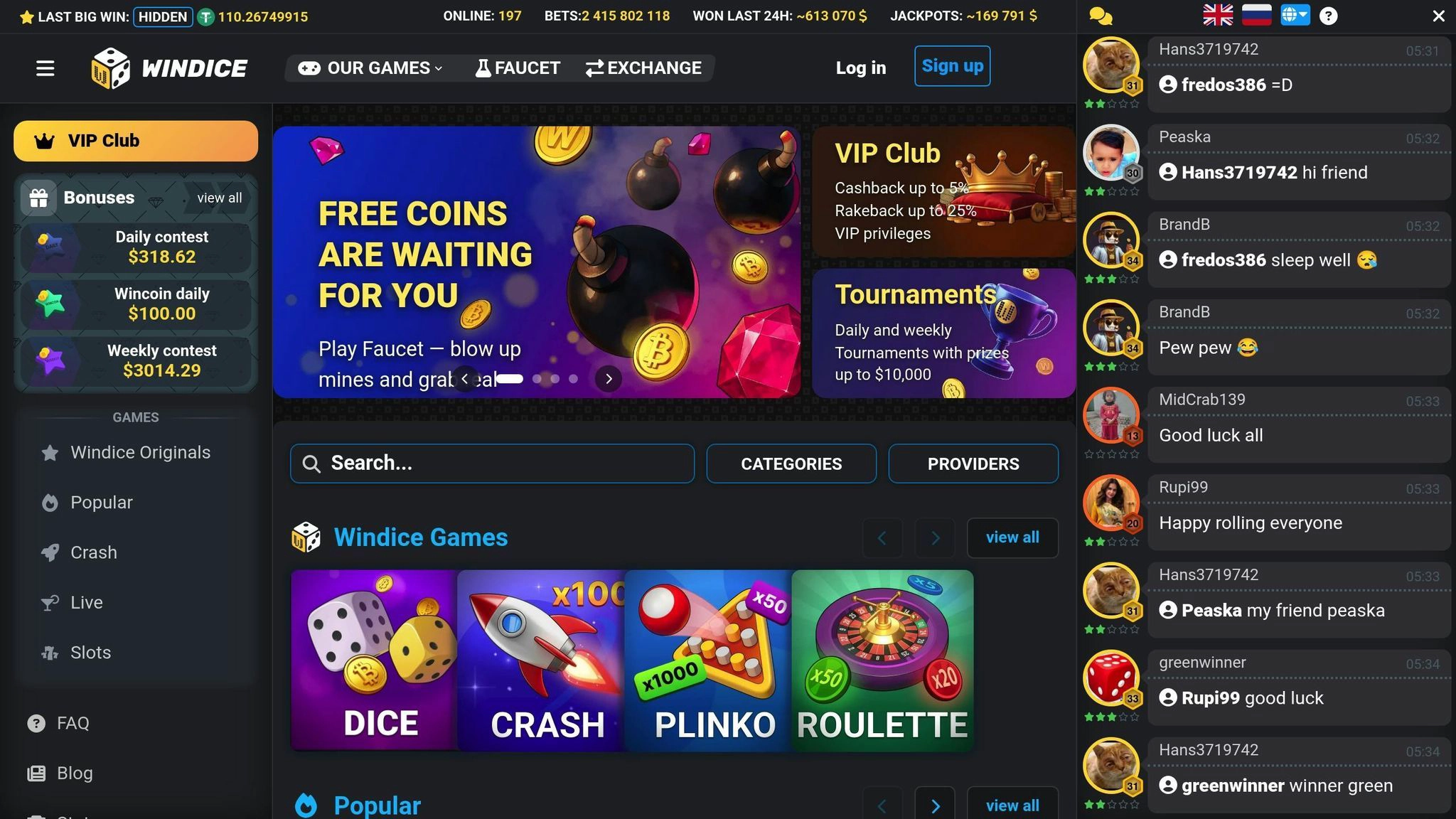
Windice combines blockchain technology with a player-focused approach that prioritizes transparency. The platform supports several cryptocurrencies - including Bitcoin, Ethereum, Litecoin, and Dogecoin - and ensures instant payouts without transaction fees. This eliminates the common headaches tied to traditional payment systems, like delays and hidden charges.
One of Windice's standout features is its active on-site chat, where players can connect, share strategies, and interact with moderators in real time. Additionally, a dedicated forum encourages feedback and allows users to validate gameplay integrity. As Peace (Ugonma) Nwankpa puts it:
The ability to check creates a 'deterrent effect' - operators stay honest because they know any user could catch them in a lie at any moment.
Windice also enhances the gaming experience with a VIP system, exclusive rewards, and a marketplace for profile upgrades. Bonuses and wagering contests further enrich the community-driven atmosphere. On top of these features, Windice integrates blockchain-verified Endorphina slots, ensuring game outcomes are fair and transparent.
Endorphina's Provably Fair Slots on Windice
Windice takes blockchain fairness to the next level by offering Endorphina's provably fair slots. These games allow players to verify every aspect of the outcome, thanks to SHA-256-based verification. Each wager is secured through a pre-published cryptographic hash - essentially a "sealed envelope" that locks in results before gameplay begins.
After playing, users can cross-check the revealed Server Seed, Client Seed, and Nonce against the game outcome using built-in or independent verification tools. This process guarantees that results remain untampered. Endorphina, known for its portfolio of over 130 games - including the popular Satoshi's Secret - maintains an average RTP of 96%. The studio is licensed in 26 jurisdictions, including by the Malta Gaming Authority, and its RNG undergoes rigorous testing by GLI using the DIEHARD and NIST test suites.
Conclusion
Blockchain technology has reshaped the concept of fairness in online gambling, replacing trust in casinos with trust in mathematical certainty. As WorldWideScienceStories highlights, blockchain doesn’t promise better odds - it guarantees honest results. And that assurance keeps players coming back.
Take Endorphina, for example. The company uses SHA-256 hashing to secure every spin with pre-published server seeds. Players can later verify outcomes using client seeds and nonces, creating a tamper-proof system. This approach replaces the opaque "black box" model with complete transparency.
Windice takes it a step further by combining Endorphina’s provably fair slots with instant cryptocurrency payouts, zero transaction fees, and an interactive community forum where players can discuss verification processes. Built-in tools allow players to check game outcomes in real time, removing the need for audits or regulatory oversight. This setup not only reinforces blockchain-enabled fairness but also underscores Windice’s dedication to a transparent, player-first approach.
These advancements signal a broader shift in the industry. Gambling platforms are transitioning from a "trust us" mindset to a "prove it" standard, with on-chain audit logs becoming the benchmark for credibility in digital gambling.
FAQs
Can I change my client seed?
Yes, you can change your client seed. It’s a player-controlled part of provably fair systems, which can be generated or adjusted before placing a bet. This gives players the ability to take an active role in verifying the fairness of their gambling experience.
Does verifying a spin require crypto or a wallet?
No, verifying a spin in provably fair systems doesn’t require a crypto wallet or cryptocurrency. Instead, it involves reviewing cryptographic hashes, seeds, and game results. These elements are publicly accessible and can be independently verified by anyone. This process guarantees fairness and transparency without needing extra tools or accounts.
What should I do if a fairness check fails?
If a fairness check doesn't pass, take a closer look at the cryptographic verification details offered by the platform. If you’re still facing issues, reach out to the platform's customer support or their responsible gaming team. They’re equipped to assist in resolving the problem and ensuring the process is clear and trustworthy.