Provably Fair Gaming: Your Questions Answered

Provably Fair Gaming: Your Questions Answered
Provably fair gaming lets you verify every game result yourself. Unlike older systems where you trust the casino's word, this method uses cryptographic tools to prove outcomes are untampered. Here's how it works:
- Transparency: Casinos provide a hashed server seed before each game. After the game ends, the unhashed seed is revealed for verification.
- Player Input: You add your own client seed, ensuring results can't be manipulated.
- Verification: Use tools to check if the server seed and game outcome match.
This system is popular in cryptocurrency casinos and gives players more control by replacing blind trust with proof. Windice, for example, uses this process in games like Dice and Mines, allowing you to verify results in real time. It’s simple: check the server seed, use your client seed, and confirm the outcome matches. No middlemen, just maths.
What Are Provably Fair Gambling Games and How Do They Work? | Casino Winners Advisor
How Provably Fair Gaming Works
How Provably Fair Gaming Works: Server Seed, Client Seed, and Verification Process
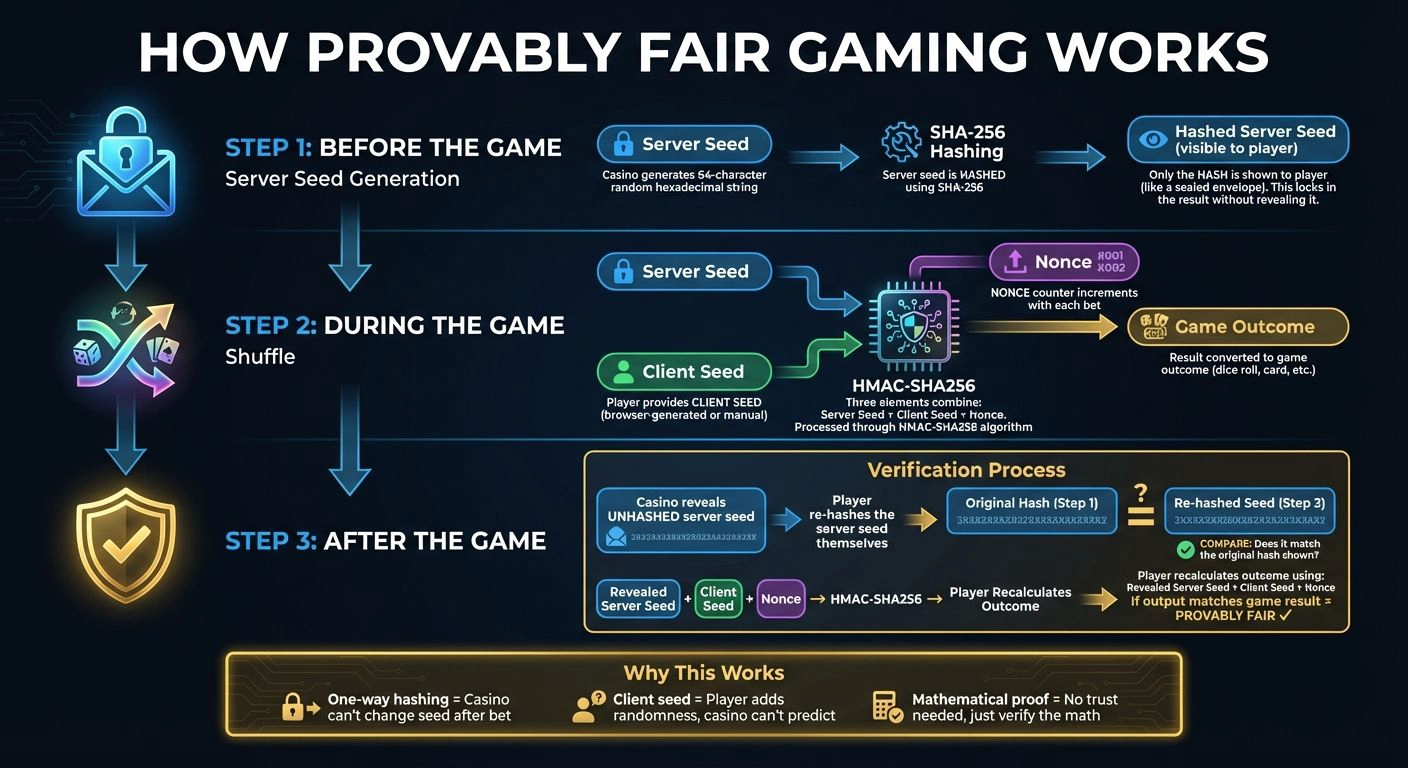
Provably fair gaming operates through the interplay of three key elements: the server seed, the client seed, and the nonce. Together, these components ensure that game outcomes are transparent, verifiable, and immune to manipulation by either the player or the casino.
Server Seed, Client Seed, and Nonce Explained
The server seed is a 64-character random hexadecimal string generated by the casino before the game begins. Instead of revealing the seed outright, the casino provides its cryptographic hash - a secure "sealed envelope" that locks in the result without disclosing it. As B3i Tech Blog describes:
"Think of it like a sealed envelope. The casino writes the result, seals it, and shows you the sealed envelope before you bet. After your bet, they open it".
The client seed, generated by your browser or entered manually, combines with the nonce - a counter that increments with each bet - to create a unique and unpredictable outcome. By incorporating the client seed, players ensure that the casino cannot pre-determine or influence the results. Explains this process as follows:
"The implementation of nonce ensures we remain committed to your client seed and server seed pair, whilst generating new results for each game played".
These three elements are processed through HMAC-SHA256, a cryptographic algorithm also used in Bitcoin transactions. The algorithm produces a hexadecimal string, which is then converted into the game-specific outcome - be it a dice roll, card shuffle, or mine location. This system forms the foundation of provably fair gaming, guaranteeing the integrity of each result.
How Hashing and Verification Work
Hashing ensures that every game outcome can be independently verified. Hashing algorithms, like SHA-256, are one-way functions, meaning it’s virtually impossible to reverse-engineer the original server seed from its hash. This protects both parties: players can’t predict results in advance, and casinos can’t alter the seed after bets are placed.
Once the game concludes, the casino reveals the unhashed server seed, allowing players to verify its integrity by hashing it themselves. Stake.us highlights why this step is critical:
"The reason we provide you with the encrypted form of the server seed is to ensure that the un-hashed server seed cannot be changed by the social casino operator, and that the customer cannot calculate the results beforehand".
To confirm fairness, players re-run the algorithm using the revealed server seed, their client seed, and the nonce for each round. If the output matches their game history, the results were fair. If not, it signals an issue. This verification can be done manually with SHA-256 calculators or through third-party tools for an impartial check.
For added security, players can regularly rotate their client seed, which prompts the casino to reveal the previous server seed for verification. This simple action ensures a fresh chain of outcomes and maintains transparency.
Provably Fair Games on Windice
Which Windice Games Use Provably Fair Technology
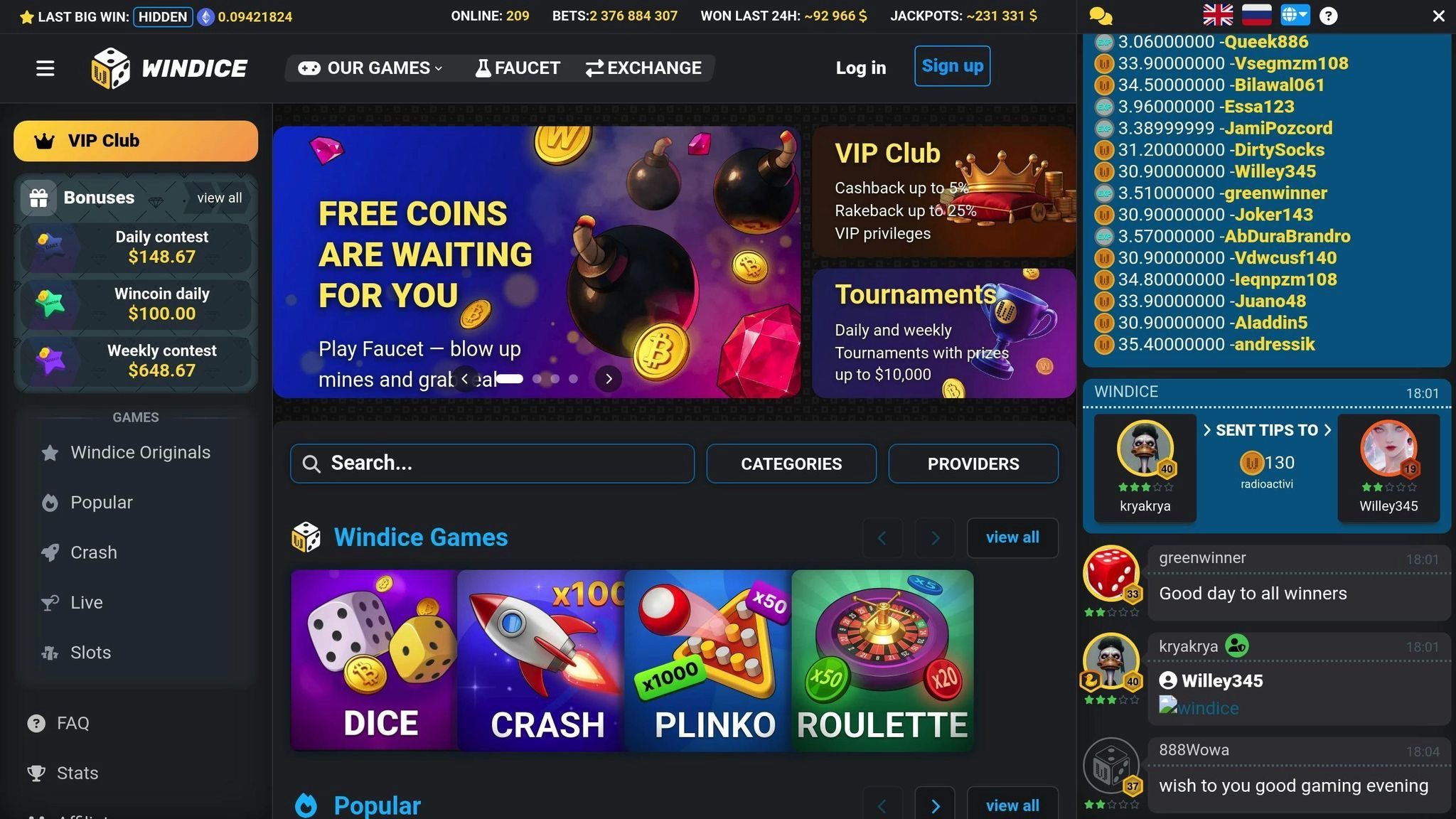
Windice incorporates provably fair technology across its in-house games, including Dice, Crash, Plinko, Mines, Limbo, HiLo, and Keno. This system ensures that every game outcome can be independently verified, staying true to the principles of fairness and transparency.
"It's not marketing - it's math".
Each round generates results that are mathematically verifiable, giving players the ability to audit outcomes on their own.
For multiplayer games like Crash, Windice employs a hash chain containing up to 10 million pre-determined hashes to ensure outcomes can be verified. In single-player games like Dice, the process involves generating a 128-character hexadecimal string using HMAC_SHA512. If the first five characters produce a number equal to or greater than 1,000,000, the algorithm continues to iterate through five-character segments of the string until it finds a valid result.
Next, let’s walk through how you can verify these results yourself on Windice.
How to Verify Game Results on Windice
Windice simplifies the process of verifying game outcomes. Before placing a bet, ensure the hashed server seed is visible - this locks in the outcome for transparency.
Once your session ends, initiate a seed rotation to reveal the unhashed server seed used in the previous session. Then, navigate to your game history or the "Provably Fair" section to locate the specific round you wish to verify. Use the revealed server seed, your client seed, and the nonce to verify the result. You can do this using Windice's built-in verification tool or an independent third-party hash calculator. Check that the server seed generates the same hash displayed before the game started and that the calculated result matches the outcome shown.
You don’t need to verify every single bet - spot-checking, especially after major wins or losses, is enough to ensure the system's reliability. For added reassurance, consider using third-party hash calculators for verification instead of relying solely on Windice's built-in tool.
Provably Fair vs Traditional RNG Systems
Grasping the distinctions between provably fair systems and traditional random number generators (RNGs) sheds light on why cryptocurrency casinos are increasingly adopting this technology. Traditional RNGs function as closed systems, generating outcomes on private servers, hidden from players' view. Provably fair systems take a different approach, leveraging cryptographic commitments to allow independent verification. This shift fundamentally changes how players interact with casinos, creating a new level of trust.
In traditional systems, fairness relies on periodic audits conducted by third-party organisations, often on a monthly or annual basis. These audits review internal server logs, which are accessible only to operators and auditors. Provably fair systems remove this dependence on intermediaries by enabling real-time verification directly by the player. Lucy, an author at BonusCasino, describes it aptly: "Provably fair is like giving the player the auditing power". Instead of waiting for audits, players can verify outcomes themselves as they happen, sidestepping static processes tied to external reviews.
Transparency and Verification: A Comparison
Here’s a side-by-side look at how traditional RNG systems compare to provably fair systems:
| Feature | Traditional RNG Systems | Provably Fair Systems |
|---|---|---|
| Transparency | Closed system; process hidden from players | Open system; cryptographic proofs and hashes are public |
| Verification | Relies on periodic audits by third-party labs | Allows immediate, independent verification by the player |
| Player Control | None – the host controls all randomisation | High – players contribute a client seed to influence outcomes |
| Trust Model | Trust in the brand, licence, and regulatory oversight | "Trust the maths" through cryptographic verification |
| Audit Trail | Internal logs accessible only to auditors/operators | Publicly verifiable records, sometimes stored on a blockchain |
Traditional RNG systems determine outcomes at the moment a bet is placed, leaving players reliant on the casino's internal processes. In contrast, provably fair systems lock the outcome in advance using a hash, ensuring that the player's client seed adds a layer of randomness. This collaborative approach to randomisation shifts the dynamic from blind trust to mathematical certainty. As New Game Network puts it, "Fairness is no longer promised, it's testable". By allowing players to verify fairness themselves, this system hands control back to the players, transforming the gaming experience.
Why Players Trust Windice's Provably Fair System
Windice's Approach to Transparency
Windice uses a verified server seed hash system to ensure game outcomes are locked in before bets are placed. By combining its server seed with your client seed, the platform makes you an active participant in generating random results. This isn't about blind trust - it's about being part of the process. Each bet updates a nonce, so even if the same seed pair is used, the outcomes remain unique. Once the round ends, the server seed is revealed, allowing you to verify results using SHA-256. As BitRollers aptly states:
"Trust has to come from code, not branding."
But Windice doesn't stop at technical precision. It also builds trust through its open and connected community.
Community Engagement and Player Trust
Windice encourages players to engage through active chats and forums, where they can share their experiences, discuss fairness, and hold the system accountable. The platform is transparent about its game mechanics, offering detailed mapping rules for games like Dice, Crash, and Mines. This lets you see exactly how hashes translate into results.
Players are also empowered to double-check outcomes themselves. High-stakes rounds can be independently verified by recording Bet IDs and using third-party hash calculators like Xorbin. If the recalculated result doesn’t match the game outcome, Windice’s support team is ready to investigate using your seeds and screenshots.
This open verification process, paired with perks like cashback and rakeback through the VIP system, ensures that fairness isn't just a claim - it's something you can test and confirm every step of the way.
Conclusion
Provably fair gaming shifts the dynamic from blind trust to verifiable proof. Instead of relying solely on a casino's reputation or private audits, you now have the ability to confirm every outcome yourself. Using cryptographic hashes, the system ensures that results are locked in and tamper-proof. This means you essentially become your own auditor. The process revolves around server and client seed verification, creating a transparent system that leaves no room for doubt.
Windice takes this concept further by putting the verification process directly in your hands. The platform publishes its hashed server seeds upfront, combines them with your client seed, and updates a nonce with each bet to guarantee unique outcomes. After each round, the revealed server seed allows you to recalculate the result and confirm it matches what was displayed. For added assurance, you can even use independent hash calculators to verify your seed data without bias.
This approach isn’t just about ensuring fairness - it’s about delivering transparency you can actively test. Performing spot-checks from time to time can help maintain the system's integrity and boost your confidence in its fairness. It’s also wise to regularly change your client seeds and verify that the hashed server seed aligns with the revealed version after gameplay. This evolution from relying on trust to verifying fairness is at the heart of provably fair gaming.
Windice exemplifies these principles, giving players full control and unmatched transparency. While traditional casinos rely on promises, provably fair gaming allows you to confirm outcomes yourself. With features like cashback, rakeback, and an active community keeping the platform accountable, Windice ensures that fairness isn’t just a claim - it’s a reality you can verify at every step.
FAQ
How can I check if a game result is fair?
To check if a game result is fair, you can compare the server-seed hash - shared before your bet - with the server seed revealed after the round. By using the server seed, your client seed, and the bet’s nonce, you can recalculate the result using the game's published formula (such as HMAC-SHA256).
This method ensures the result hasn’t been tampered with and confirms the game runs transparently. Many platforms also offer tools or step-by-step guides to make these checks straightforward, allowing you to verify fairness on your own.
What is a client seed, and how does it ensure fair gaming outcomes?
The client seed is a random value provided by the player, working together with the server seed and nonce to generate a random result using cryptographic methods like HMAC-SHA256. By letting players contribute to the randomisation process, the client seed gives them a sense of involvement in ensuring the fairness of outcomes.
This setup allows players to independently confirm that game results haven’t been tampered with by the casino, promoting transparency and reinforcing trust in the platform's integrity.
What makes provably fair gaming more transparent than traditional RNG systems?
Provably fair gaming offers a new level of clarity, giving players the tools to confirm the fairness of every game round on their own. Here’s how it works: before a game starts, the casino shares a cryptographic hash of the server seed. This hash ensures the outcome is set in advance but remains concealed during gameplay. Once the game ends, the server seed is disclosed, allowing players to compare it with the hash and verify that nothing was altered.
This approach removes the need to rely on hidden "black-box" random number generators (RNGs) that only external auditors can assess. Instead, it puts the power directly in the hands of players, building trust and confidence in the platform’s fairness.