How Leaderboards Motivate Casino Players
How Leaderboards Motivate Casino Players
Leaderboards in online casinos transform casual gaming into a competitive, engaging experience by leveraging natural human tendencies like social comparison and goal-setting. They provide players with real-time feedback, allowing them to track progress, measure achievements, and compete with others. This motivates players to stay active, set higher goals, and return frequently to improve their standings.
Key takeaways:
- Social Comparison: Players instinctively compare their rankings, pushing themselves to climb higher.
- Real-Time Feedback: Constant updates on performance keep players engaged and focused.
- Community Connection: Public rankings and social features create a sense of belonging and interaction.
- Time-Sensitive Challenges: Daily or weekly resets encourage consistent participation.
Platforms like Windice use leaderboards effectively by combining them with rewards, VIP progression, and community features, driving both player activity and long-term loyalty.
The Psychology of the Casino (Why You Will Never Win)
The Problem: Why Players Lose Interest in Casino Gaming
Many casino players eventually lose interest, and while the reasons might not always be obvious, they tend to follow predictable patterns. By identifying these challenges, we can better understand why engagement wanes - and why leaderboards can be a game-changer.
No Way to Track Progress
When players can’t measure their progress, gaming becomes a passive activity. Without real-time feedback or visible metrics, players are left with a vague "just do your best" mindset, which doesn’t inspire long-term motivation.
A study from 1975 by Latham and Baldes found that setting clear, specific goals boosted team performance from 60% to 90% - and this was achieved without financial rewards. The same concept holds true for casino gaming. Players who can’t track their wins, losses, or overall standing lack a clear sense of achievement. This absence of measurable progress leaves players feeling ineffective rather than skilled or competitive.
Without a way to track progress, the competitive drive that keeps players engaged naturally fades.
Missing Competitive Element
The lack of progress tracking also weakens the competitive aspect of gaming. Without the ability to compare performance, the experience becomes repetitive and loses its thrill. Research shows that players perform better when given specific, challenging goals rather than vague encouragement.
Richard N. Landers, a professor at the University of Minnesota, explains this dynamic:
The goal provides the individual a measure for 'excellent' performance against which to judge his or her own performance.
Without a benchmark, players are left wondering, Am I doing well? How do I stack up against others? This uncertainty erodes motivation. The global video game industry, worth $159.3 billion and home to nearly 2.7 billion players, increasingly emphasizes social interaction as a critical factor in keeping players engaged.
Weak Community Connection
A lack of community connection further diminishes player engagement. Research shows that players who experience "joy in isolation" report lower satisfaction compared to those who play on platforms with social features. When achievements go unnoticed and there’s no sense of belonging, players feel less invested in continuing.
Jose Esteves, Associate Dean and Professor at IE Business School, highlights this point:
Social interactions among players in online games increase their enjoyment and satisfaction, compared to games with no social elements.
Without public rankings or visibility, there’s no accountability to maintain or improve performance - and no recognition when milestones are achieved. A study conducted between January 2022 and March 2024, involving 1,389 Irish primary school students using a digital game with an infinite leaderboard, found that 80.12% reported positive experiences. However, those without social features or community connections consistently showed lower engagement levels.
These challenges - lack of progress tracking, diminished competition, and weak community ties - underline why leaderboards are so effective. They provide clear metrics, encourage competition, and foster a sense of community, all of which are essential for keeping players engaged.
How Leaderboards Trigger Player Motivation
Leaderboards tap into deep psychological drives, turning casual gaming into a competitive experience. They leverage competition, recognition, and time-sensitive challenges to push players toward improving their rank and staying engaged.
Competition and Ranking
Leaderboards thrive on Social Comparison Theory - our innate tendency to measure ourselves against others . Players naturally compare their performance to those ranked higher, which sparks a desire to bridge the gap. This process, known as "upward comparison", motivates players to adjust their actions and strive for better results .
Richard N. Landers from the University of Minnesota captures this idea perfectly:
Leaderboards provide the user with several potential goals. The user should be motivated to reach one of these goals and regulate his or her behavior by reducing the discrepancy between the desired goal... and actual performance.
The competitive aspect isn't just theoretical - it’s measurable. Research shows that goal difficulty influences performance, with effect sizes ranging from d = .52 to d = .82. For challenging objectives like climbing a leaderboard, goal commitment explains 12.3% of the variance in performance. Interestingly, players often set their sights on ambitious yet attainable goals near the top of the leaderboard, treating these ranks as personal milestones.
Public Recognition and Achievement
Leaderboards also provide something players crave: visible proof of their achievements. This taps into the need for competence, giving players a sense of mastery and effectiveness . As Omar Ganai and Steven M. Ledbetter from Habitry note:
A great leaderboard supports competence, which is the satisfaction you get when you complete a challenging goal. You feel masterful and effective.
This visibility offers more than just personal satisfaction - it creates social acknowledgment. A study involving 824 consumers found that gamification features like leaderboards positively influenced emotional, cognitive, and social engagement with brands.
However, public rankings have a downside. Constantly being at the bottom can feel like harsh feedback, as Lopez from the Los Angeles Times points out:
Being consistently at the bottom of the ranking list is negative feedback.
To keep lower-ranked players motivated, platforms often reframe their performance. Instead of simply showing a low rank, they might highlight relative success, such as "You performed better than 70% of players".
Time Pressure and Fear of Missing Out
Adding time constraints to leaderboards ramps up the urgency. Time-sensitive challenges align with the SMART goal framework - specific, measurable, attainable, realistic, and time-bound. Daily or weekly leaderboards turn vague ambitions into immediate deadlines, pushing players to act.
A 1975 study revealed that specific, time-bound goals improved performance from 60% to over 90%. The difference? A clear deadline replaced open-ended instructions like "do your best."
Leaderboards that focus on streaks amplify this effect. Players are motivated to log in daily to maintain their streaks, fearing the loss of progress if they skip a day. When combined with public rankings and ticking clocks, this creates a powerful feedback loop that keeps players coming back for more. These strategies highlight how leaderboards fuel both short-term action and sustained engagement over time.
How Windice Uses Leaderboards to Drive Player Activity
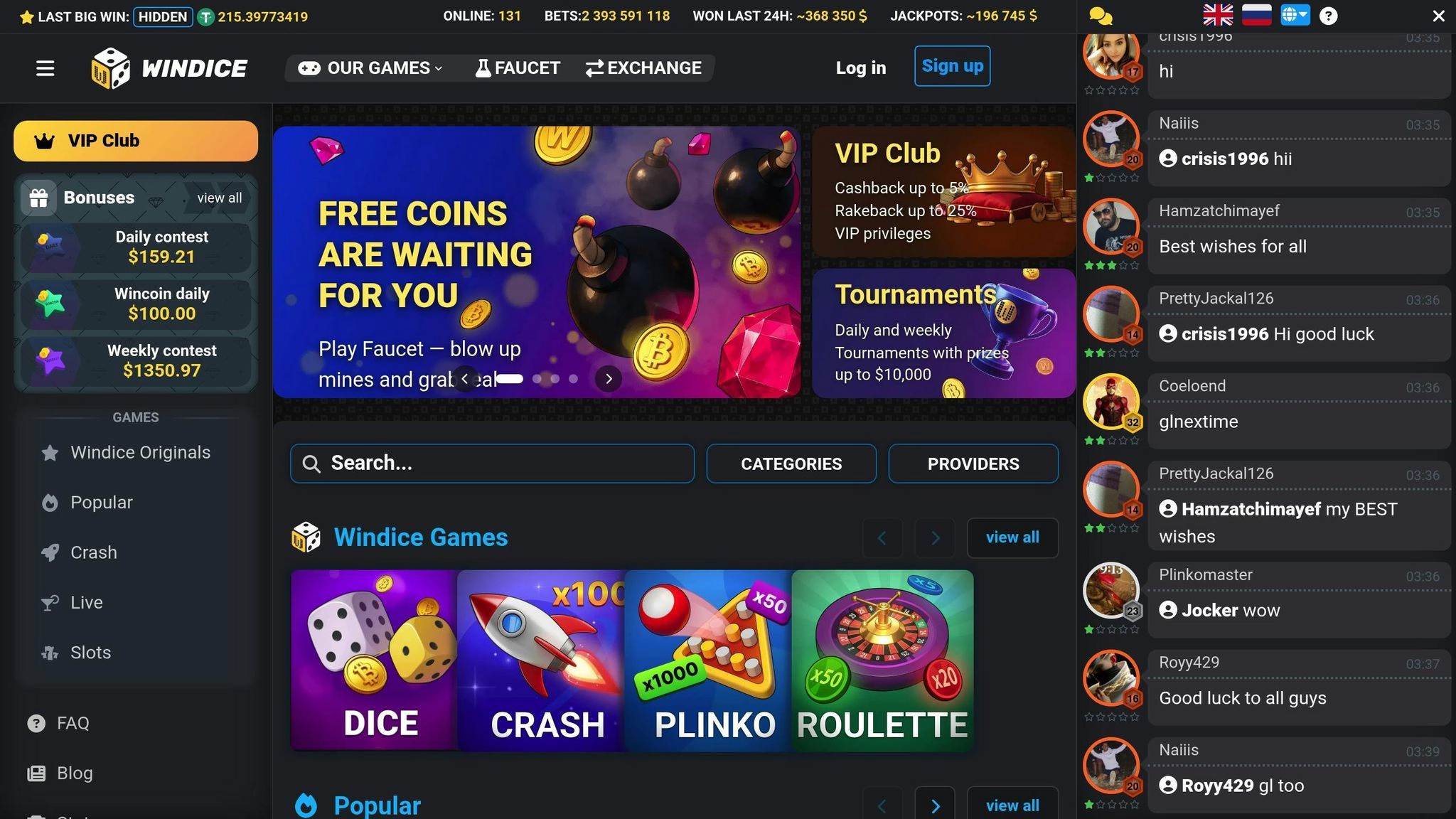
Windice has crafted a system that blends daily profit tracking, VIP progression, and community interaction to keep players engaged and coming back for more.
Daily USDT Profit Leaderboard
At the heart of Windice's strategy is the daily USDT profit leaderboard, which ranks players based on their profits within a 24-hour window. The leaderboard resets daily, creating a sense of urgency and encouraging frequent participation. Players can track their real-time standings at Windice's stats page, giving them instant feedback and motivation to improve their performance.
This approach taps into the behavioral impact of tangible rewards. A 2021 study in Addictive Behaviors by Hyoun S. Kim and Matthew Rockloff found that players who could exchange virtual credits for tangible rewards placed more bets and wagered higher amounts over a seven-day period compared to those without rewards. The takeaway? Small, tangible incentives can significantly alter player behavior, driving higher engagement and activity.
The 24-hour reset also introduces a clear deadline, which research suggests can boost performance. Studies show that when paired with specific deadlines, challenging goals can increase success rates from 60% to over 90%. This structure ensures that players remain focused and motivated, as they constantly strive to outperform themselves and others.
Connection to VIP Benefits
The leaderboard isn't just about daily bragging rights - it ties directly into Windice's six-level VIP system. Players who perform well on the leaderboard make progress toward VIP perks like cashback, rakeback, and exclusive rewards. This connection transforms daily victories into long-term benefits, giving players a reason to stay committed beyond a single day.
This dual-reward strategy addresses a core motivational challenge. For high-difficulty goals, such as climbing competitive leaderboards, goal commitment accounts for about 12.3% of performance variance. By linking leaderboard success to VIP progression, Windice ensures players have both immediate and ongoing incentives to stay engaged.
As Sergei Davidov, Growth Manager at Common Ninja, explains:
The recognition of being on a leaderboard - whether through top rankings, badges, or other rewards - serves as a powerful motivator.
The VIP system also leverages "upward identification", where players aspire to the levels and perks enjoyed by top-ranked users. This creates a clear, aspirational path that extends beyond daily competition, keeping players invested in their progress over time.
Community Sharing and Discussion
Windice takes the competitive experience a step further by fostering social interaction. Through its on-site chat and dedicated forum, the platform transforms leaderboard competition into a community-driven activity. Players share strategies, celebrate victories, and even hold each other accountable, adding a social and narrative element that rankings alone can't provide.
Public recognition plays a key role here. As Davidov notes:
Publicly displayed rankings foster accountability, as individuals know their performance is visible to others. This visibility creates a psychological commitment to maintain or improve standing.
The chat feature includes elements like "rain" and tipping, allowing players to share their winnings and build connections. Meanwhile, the forum provides a space for deeper discussions about strategies and tactics. This combination of real-time interaction and long-form content keeps the community engaged, even between competitions.
Research backs up the importance of social features in gamification. These elements have been shown to positively influence emotional, cognitive, and social engagement. By turning leaderboards into a conversation starter, Windice ensures players feel like part of a larger community, rather than isolated competitors. The result is a more immersive and connected experience that keeps players coming back.
Together, these systems create a dynamic environment where every interaction reinforces long-term player engagement and commitment.
What Leaderboards Deliver for Players and Platforms
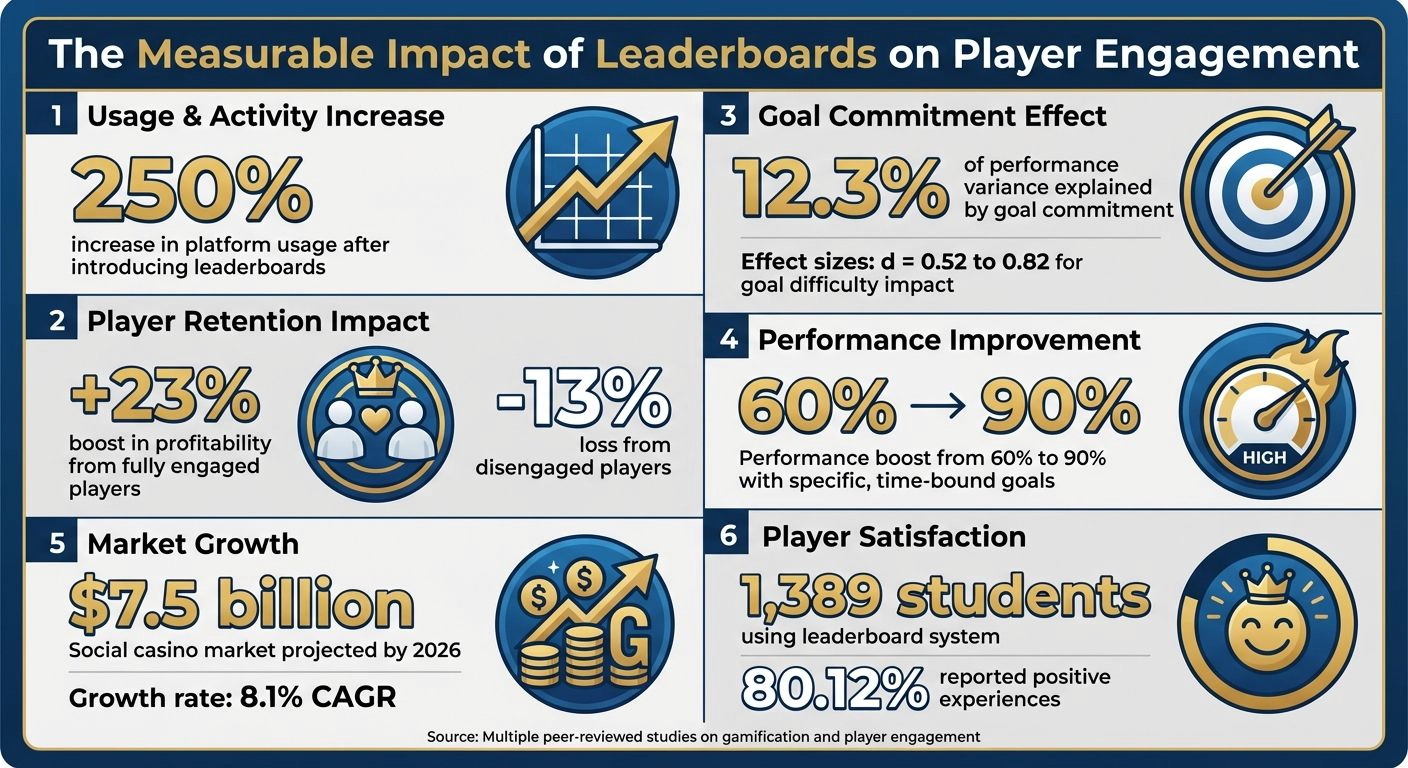
How Leaderboards Impact Casino Player Engagement and Retention
Leaderboards are more than just a ranking system - they drive player engagement, boost retention, and create a more satisfying gaming experience.
More Frequent Player Activity
Leaderboards naturally inspire players to log in more often and stay engaged longer. By setting ambitious goals, players feel motivated to close the gap between their current rank and their desired position. This can lead to significant increases in platform usage. For instance, one study reported a 250% jump in usage after introducing a leaderboard system.
What makes leaderboards so effective is their ability to provide real-time feedback. Unlike static achievements, leaderboards show players how they stack up against others immediately. This dynamic feedback encourages players to come back repeatedly to improve their standing. For mid-tier players especially, seeing a few competitors just ahead of them can make the next milestone feel within reach - prompting them to play "just one more session". Features like daily resets also keep the experience fresh, giving players regular opportunities to climb the ranks.
This consistent engagement sets the stage for stronger long-term loyalty, as explored in the next section.
Higher Player Retention
Frequent activity often translates into lasting retention, and leaderboards play a big role in this. The ongoing competition they foster keeps players invested over time. Social comparison, visible progress, and recurring challenges provide players with reasons to stick around. Fully engaged players, in fact, have been shown to generate an average 23% boost in profitability, while disengaged users can cost platforms a 13% loss.
Leaderboards also tap into core psychological needs. They satisfy the desire for competence (mastering skills), relatedness (connecting with others), and autonomy (pursuing personal goals). As Richard N. Landers highlights:
The presence of a leaderboard was successful in motivating participants to performance levels similar to that of difficult and impossible goal-setting.
Platforms that pair leaderboards with social features, like chat or forums, see even stronger retention. The social casino market is a great example of this trend, with the sector growing at a CAGR of 8.1% and projected to hit $7.5 billion in revenue by 2026.
Better Player Experience
Leaderboards don’t just keep players coming back - they also make the gaming experience more rewarding. By turning gameplay into visible achievements, leaderboards give players a sense of progress and accomplishment. This recognition enhances satisfaction and loyalty. Seeing their scores displayed alongside rankings reinforces players' enjoyment and sense of presence in the game.
Both upward (aspiring to beat higher-ranked players) and downward (maintaining a lead over others) comparisons add to the fun. As Jose Esteves, Associate Dean at IE Business School, puts it:
Social interactions among players in online games increase their enjoyment and satisfaction, compared to games with no social elements.
When combined with community features like forums or in-game chat, leaderboards create a vibrant environment where players feel connected and motivated. It’s not just about the game itself but about being part of a competitive, thriving community that makes the experience so engaging.
Conclusion: Why Leaderboards Work in Online Casinos
Leaderboards tap into three core human needs: competence, connection, and control. They turn solo gameplay into a dynamic, competitive experience, blending social comparison, goal-setting, and public recognition to keep players coming back for more.
As Lloyd Melnick, GM of Chumba at VGW, highlights:
A well designed leaderboard is consistent with three needs: Competence, Relatedness, and Autonomy.
In essence, leaderboards reflect a player's skill (competence), foster competition within a community (connection), and allow for personalized goals (autonomy). This trifecta ensures an engaging experience.
Windice offers a great example of this in action. Its Daily USDT Profit Leaderboard resets frequently, giving players fresh chances to climb the ranks. Features like active chat moderation, social tipping, and forums where players share strategies and celebrate wins create an environment where competition feels inclusive rather than isolating.
Research supports these practices. Studies reveal that strong goal commitment can account for 12.3% of performance variance, highlighting how leaderboards enhance player motivation and engagement.
FAQs
How do leaderboards motivate players in online casinos?
Leaderboards are an effective way to keep players engaged in online casinos by leveraging psychological triggers like competition, recognition, and rewards. They spark a friendly sense of rivalry, pushing players to improve their performance and aim for higher rankings. This not only keeps the experience exciting but also gives players a sense of achievement when they secure a top spot.
Another great feature of leaderboards is the instant feedback they provide. Players can monitor their progress in real time and see how they stack up against others. For example, Windice's daily USDT leaderboards showcase the top performers, motivating players to climb the ranks and earn exclusive rewards. This competitive setup not only makes gameplay more thrilling but also builds a stronger community by encouraging interaction and shared goals.
How do leaderboards inspire players to compete and improve?
Leaderboards appeal to the deep-seated human drive for achievement and recognition, serving as a strong motivator. They let players track their rank compared to others, sparking friendly competition and encouraging them to push their limits.
Beyond competition, leaderboards build a sense of community and status. Players aim to climb the ranks, not just for rewards but also for the acknowledgment that comes with it. This blend of rivalry and social validation keeps players engaged and committed to improving.
How do leaderboards on Windice motivate players and keep them engaged?
Windice leverages leaderboards to create a thrilling and interactive gaming environment, tapping into players' natural drive for competition and recognition. A standout feature is the daily USDT profit leaderboard, which highlights the top-performing players. This not only motivates others to stay engaged but also inspires them to climb the rankings, adding an extra layer of excitement and achievement to the experience.
Beyond just rankings, leaderboards give players real-time insights into their performance, making their progress feel more tangible and encouraging continuous improvement. Paired with community-focused features like an active chat and social rewards, these rankings cultivate a sense of camaraderie and friendly competition, ensuring players remain entertained and connected.










 1754
1754